To avoid overpaying at Korean restaurants, compare a few nearby menus before sitting down, check what each price includes and confirm the total before ordering seafood marked “market price.” Those are the habits I recommend as a Korean diner, especially if you cannot easily discuss prices in Korean.
In my experience, looking just beyond the busiest tourist street often gives me more everyday restaurants to compare. I check the menu before choosing: a higher price may reflect a different portion, location or meal format.
1. Compare meals with the same portion and included items
Compare two or three menus along your route. For soup or pork cutlet, check whether rice and side dishes are included. For barbecue, compare the meat weight and minimum order as well as the price. Our Seoul market guide explains the different meal formats at the major markets.
2. Read the menu behind the photographs
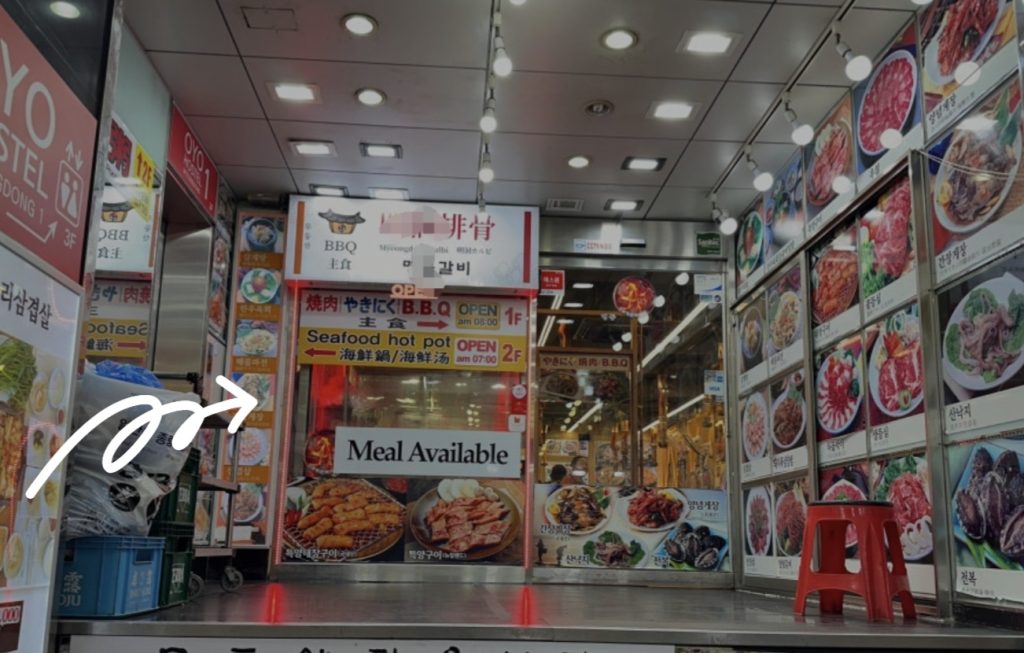
Multilingual signs and food photographs can help you order. The photograph above illustrates that signage; it does not show whether the restaurant charges unfairly. Look for the price, serving size and minimum order beside the dish you want.
3. Use everyday meal prices as a personal reference
At the ordinary restaurants I use, I often think of ₩9,000–₩12,000 as a reference range for an individual meal such as seolleongtang (설렁탕, ox-bone soup) or donkkaseu (돈까스, pork cutlet). For samgyeopsal (삼겹살, pork belly), my reference is about ₩18,000 for a 150g serving.
| Food | My everyday comparison point | What to compare |
|---|---|---|
| Seolleongtang or pork cutlet | About ₩9,000–₩12,000 per individual meal | Regular or premium version; portion; rice and soup |
| Samgyeopsal | About ₩18,000 for 150g | Weight per serving; minimum order; extras |
These figures are my personal experience-based reference points, not a verified nationwide average or a quote from a particular restaurant. Prices vary by area, ingredients, serving size and restaurant. Paying more does not by itself mean you have been overcharged.
Compare like with like. A premium soup with extra meat is different from a regular bowl; a pork cutlet set with several included items is different from a smaller standalone dish. For more help recognising meals and ordering them, see our guide to five Korean foods.
4. At Korean BBQ restaurants, check the grams beside “one serving”
The words “one serving” do not give you the full comparison. Read the weight beside the price: two restaurants can charge the same amount while providing different quantities of meat.
Calculation example using my reference price above: two 150g servings at ₩18,000 each give you 300g of meat for ₩36,000, before rice, stew or drinks. For comparison, divide a serving price by its weight and multiply by 100 to get the price per 100g: ₩18,000 ÷ 150 × 100 = ₩12,000. This is an illustration, not a current restaurant quote.
Also check the minimum order and whether rice or stew costs extra. A listed serving of pork belly is not necessarily a complete one-person meal. Your final bill depends on how many servings you order and what you add.
- 고기 1인분은 몇 그램인가요?
How many grams of meat are in one serving? - 최소 몇 인분부터 주문할 수 있나요?
What is the minimum number of servings we can order? - 밥과 찌개는 포함인가요, 별도인가요?
Are rice and stew included, or do they cost extra?
Our Korean BBQ ordering guide covers more of the meal format and dining etiquette.
5. Learn to recognise 시가 and 싯가 on seafood menus

On seafood menus, you may see 시가, or the spelling 싯가, instead of a number. This means market price: you need to ask for the price that applies to your order.
The menu photograph I took for this guide shows several squid dishes labelled 싯가, alongside other dishes with numeric prices. Recognising those two Korean characters gives you a practical reason to pause and ask before ordering.
If you are unfamiliar with seafood prices or cannot understand the explanation, my advice is to choose a dish with a clearly stated numeric price and confirm its portion. If you want a market-price dish, establish the quantity and total first.
- Is the price per animal, per plate or per kilogram?
- What quantity will you receive?
- Are there separate preparation, cooking or table-setting charges?
- What is the total for the quantity you have chosen?
A useful sentence to show staff is:
이 양으로 주문하면 추가 비용까지 총 얼마인가요?
What is the total for this quantity, including any extra charges?
If needed, ask staff to type the amount into a calculator or show it on a phone. For seafood priced by weight, confirm the bill for the final weight before agreeing to the order.
6. Read recent reviews and look at menu photographs before visiting
I recommend checking reviews once before visiting an unfamiliar restaurant. Look beyond the overall star rating: recent menu photographs and descriptions of what people ordered are more useful for understanding the likely bill.
- Can you see the price and serving weight in a recent menu photo?
- Does a food photograph explain how many servings were ordered?
- Do reviewers mention a minimum order or extra charges?
- Do several recent reviews describe the same problem with price explanations or billing?
A repeated issue is a reason to compare another restaurant. One old complaint alone does not establish how a business operates today, and an old menu photo does not guarantee the current price. Confirm the menu at the restaurant before ordering.
7. Make the final bill understandable before the food arrives
If the explanation is unclear, there is no need to rush into an order. Ask for the price in writing or choose another dish or restaurant before committing. At checkout, compare the receipt with the items and quantities you ordered.
Keep the menu or written price available until checkout. Compare the receipt with the dishes, serving counts and agreed extras; if an item is unclear, point to that line and ask staff to explain it.