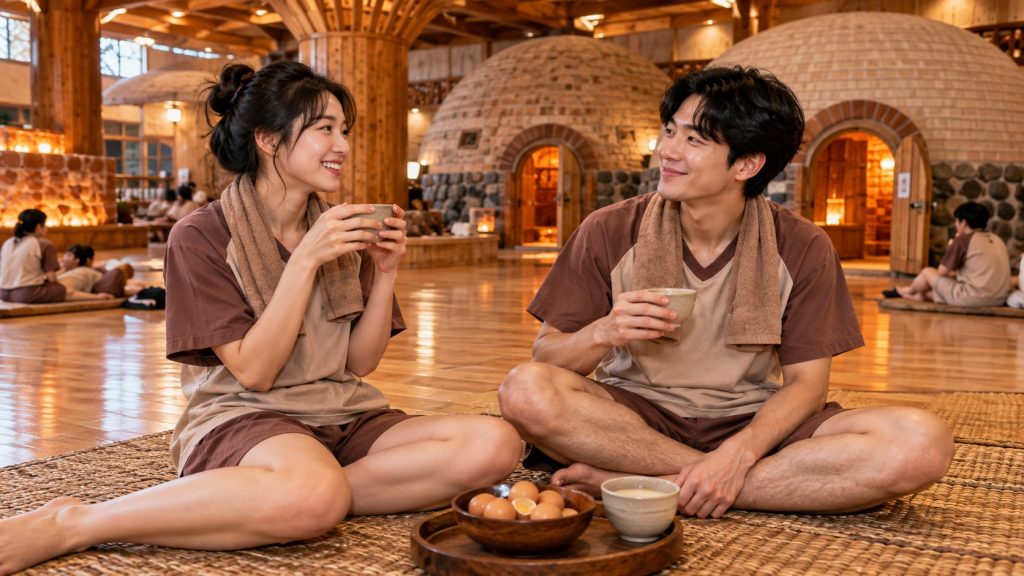
Korean everyday activities range from a short singing session to a reserved cooking class. Choose one that fits your interests, payment options and access conditions rather than trying all five in one day. The venue examples below include source links and questions to ask before booking.
Choose by the main decision you need to make
| Activity | Best planning format | Confirm before paying |
|---|---|---|
| Jjimjilbang | A separate relaxation block | Bathing versus shared-area admission; length of stay |
| PC bang | A nearby stop once account access works | Your game, account region and visitor login |
| Traditional market | One meal or one shopping purpose | Separate cooking and restaurant charges for seafood |
| Coin karaoke | A flexible short break | Songs versus minutes; payment and song availability |
| Cooking class | A fixed booking around which to plan sightseeing | Teaching language, ingredients and cancellation terms |
For a flexible day, choose a market or karaoke stop near an existing destination. For a booked class, keep its start time fixed and leave nearby sightseeing flexible. Add admission, food, materials and transport when comparing costs; an entrance price may exclude the service you want. The examples below turn these decisions into addresses, search terms and questions to use at the venue.
Turn the five ideas into a visit you can arrange
1. Jjimjilbang: separate the sauna price from extras
Visit Seoul’s Venue G Aqua 24 listing gives basement level 2, 347 Hwagok-ro, Gangseo-gu, with Gayang Station, Line 9, Exit 8 as the approach. It lists adult daytime sauna admission at ₩12,000, adult nighttime admission at ₩14,000 (20:00–06:00), and jjimjil clothing rental at ₩2,000 separately. The regular closure is the third Wednesday, with the preceding day closing at 23:00.
For a daytime visit, the listed sauna price plus clothing rental adds to ₩14,000 per adult. That arithmetic does not establish unlimited staying time or every facility’s inclusion. Ask “찜질방 이용과 옷 대여가 포함돼 있나요?” (Does this include the jjimjilbang and clothing rental?) and “추가 요금은 언제부터예요?” (When do extra charges begin?). Read the bathhouse guide for what to wear and how to use the bathing area.
2. PC bang: check the game before buying time
In your map app, search “PC방” near the station where you are already staying. Open the exact branch, save its Korean name and show staff the game title and your account’s region. Ask “이 계정으로 게임할 수 있나요?” (Can I play using this account?) before loading a prepaid balance. If the account cannot be used, choose another activity rather than paying to discover that later. A specific branch is not recommended here because visitor login access has not been verified.
3. Traditional market: choose shopping or a seafood meal
Use our Namdaemun, Dongdaemun and Noryangjin comparison to pick a market. Namdaemun is a general-shopping starting point, Dongdaemun suits clothing and accessories, and Noryangjin suits a seafood-focused visit. For seafood, write down the fish price and the separate preparation or restaurant charges before agreeing. A market visit works best with one purpose, not a promise to eat everything.
4. Coin karaoke: compare the charging unit first
Search “코인노래방” near your next stop. Before paying, read whether the displayed amount buys songs or minutes. A hypothetical ₩1,000 for three songs and ₩1,000 for ten minutes are different products, even though the headline price is the same; these amounts are examples, not verified branch prices.
Ask “곡 수로 계산하나요, 시간으로 계산하나요?” (Is this charged by songs or by time?) and “두 명이 같이 들어가도 되나요?” (Can two people enter together?). Find one song you want in the catalogue before adding a large balance. A staffed room-style 노래방 is a different format; compare the room, group size and extras rather than price alone.
5. A hands-on class: kimchi or fragrance
Museum Kimchikan: exhibition entry and a class are separate decisions
Visit Seoul’s museum listing gives 35-4 Insadong-gil, near Anguk Station, Line 3, Exit 6. Published exhibition hours are 10:00–18:00, last entry 17:30, with Monday and specified holiday closures. Its FAQ describes individual exhibition visits without a reservation, subject to restrictions during group visits; this does not reserve a kimchi-making class.
For hands-on participation, open the museum’s experience reservation page and obtain a session confirmation showing the date, start time and participant count. Ask “영어로 진행하는 김치 만들기 수업인가요?” (Is this a kimchi-making class taught in English?). For a vegan participant, ask “액젓이나 새우젓이 들어가나요?” (Does it contain fish sauce or salted shrimp?). If the session’s language, ingredients or availability cannot be established, plan an exhibition visit instead of assuming admission includes a class.
A fragrance-making alternative in Seongsu
If cooking does not suit your group, compare a fragrance class at Dotnote Seongsu, 2F, 6 Yeonmujang-gil, Seongdong-gu. Walkerhill’s published partner package identifies this location and describes a 60-minute class. That page sells a hotel package with a workshop voucher; its room price is not the price of a standalone class.
For a standalone visit, use Dotnote’s class page to reach the exact branch’s booking options. Confirm the teaching language and the product and bottle size for your chosen session. Ask “영어로 수업을 들을 수 있나요?” (Can I take the class in English?). Do not travel to the hotel expecting the workshop to be there: the named class location is in Seongsu. Plan one class plus a nearby meal, with Seoul Forest optional; the Seongsu route covers the surrounding neighborhood.
Class location and the partner-package description checked October 16, 2026. Standalone prices, English instruction and seats have not been verified. When comparing a pottery class instead, establish the collection or shipping date before paying; a finished piece may not be ready to take away that day.
Tourism listings rechecked October 16, 2026. The museum FAQ labels some information as of 2025; it is not live class availability. Venue prices above are published listing values, while the karaoke numbers are hypothetical comparisons. Use the linked venue pages to confirm the option you want.
Detailed guides and next steps
For bathhouse etiquette and admission questions, use the jjimjilbang guide. For differences between shopping, clothing and seafood markets, use the Seoul market guide. Before a timed booking, save the exact venue address, check the teaching language and note the cancellation deadline.