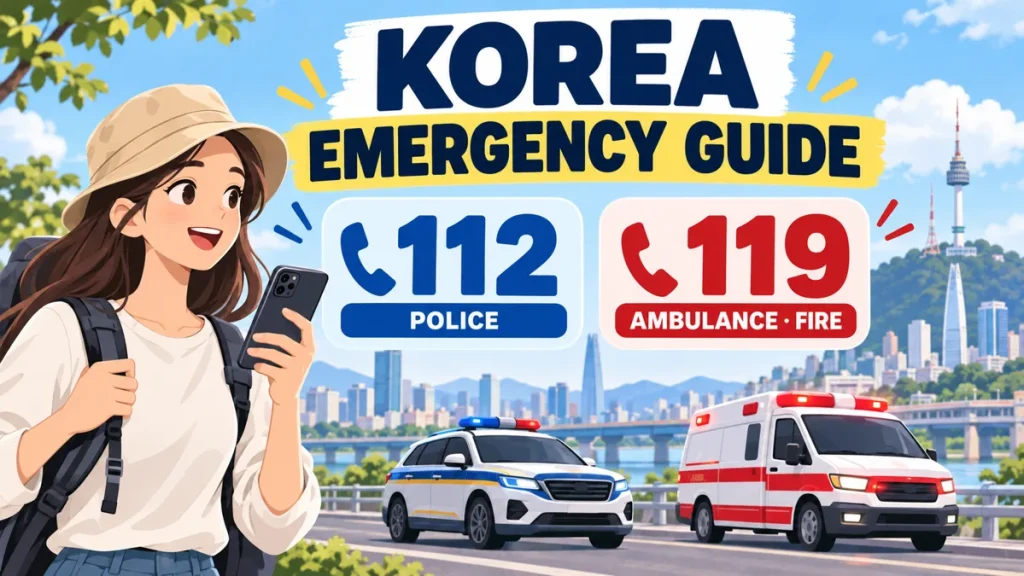
For a first-time visitor, remembering a number is only half the preparation. The harder part is explaining where you are when you feel frightened, your friend is unwell, or the address on your booking is unfamiliar. This guide gives you a simple calling order and short phrases you can save on your phone.
Prepared by SomethingMania. Official information checked: October 3, 2026. This is a travel communication guide; follow the emergency dispatcher’s instructions.
112 vs 119: Which Number Should You Call?
The main emergency numbers in Korea are 112 for police and 119 for an ambulance, fire or rescue. If you do not speak Korean, ask for an interpreter as soon as the call connects. Give your location and briefly explain what has happened.
| Number | Use it for |
|---|---|
| 112 | Police assistance for crime, violence or an immediate threat to your safety. |
| 119 | An ambulance, fire response or rescue. |
| 1330 | Tourist information, travel interpretation and tourist complaints. |
The Korea Tourism Organization’s emergency FAQ identifies 112 and 119 as the emergency contacts. For urgent danger or a serious medical emergency, contact the appropriate emergency service directly.
Examples: if someone is threatening you, request police help through 112. If someone needs an ambulance, or you see a fire, call 119. Describe what you can observe rather than trying to diagnose a medical condition.
How to Call 112 or 119 Without Speaking Korean
- Call the appropriate number: dial 112 or 119 directly while in Korea, using your phone’s dialler.
- Request language help: say “English please” or “Interpreter please.” State another language if you need it.
- Give the location: city, address or a clearly identified nearby landmark.
- Explain the problem: what happened, how many people need help, and any immediate danger.
- Answer the dispatcher’s questions: stay on the line and follow their instructions.
VISITKOREA’s international visitor safety guidance explains that callers can request a professional interpreter. This does not mean every person answering the phone speaks English, so ask for language assistance clearly.
Use short statements. You do not need to tell the whole story in one sentence. Location, the type of help required and the immediate problem are useful starting points.
Short Emergency Phrases You Can Read Aloud
The following are sample sentences, not fixed wording required by the authorities. Replace the location with your actual address or landmark.
For an ambulance or rescue: 119
English please. I need an ambulance.
I am at [hotel name and full address].
One person is injured.
My phone number is [callback number].
If relevant, describe whether the person is awake and breathing. Let the dispatcher guide you through the next steps.
For police assistance: 112
English please. I need the police.
I am at [location].
Someone is threatening me.
There are [number] people involved.
Choose words that match the actual situation. For example, “My bag was stolen” describes a different event from “Someone is following me.” Do not describe a lost item as theft unless you believe it was stolen.
A sentence to show nearby staff
Please call 119 for me.
119에 신고해 주세요.Please call 112 for me.
112에 신고해 주세요.
How to Explain Your Location in Korea
Prepare your accommodation’s Korean address before you need it. A saved booking screenshot should include the full address, hotel name and phone number, not just the brand logo.
The National Fire Agency’s 119 reporting guidance recommends giving the address and, if it is unknown, identifying nearby buildings or location markers. It also advises turning on smartphone GPS.
- At a hotel: hotel name, street address, floor and room number.
- Near a station: station name, exit number and whether you are inside or outside.
- In a large building: building name, floor and the entrance nearest to you.
- On a hiking route: mountain name and any trail sign or official location-marker number you can read safely.
For example: “I am outside Exit 6 of Gwanghwamun Station, beside the entrance.” This is a location-description example, not a suggestion to move there during an emergency.
Keep location services on if possible, but still tell the dispatcher where you are. Do not assume that a map pin or automatic location detection has provided everything needed to find you.
What If You Cannot Speak on the Phone?
The official 112 reporting portal lists telephone, text, recorded-audio and video reporting options. If speaking is unsafe, use a suitable available alternative and explain both your location and the danger.
VISITKOREA also recommends the Ministry of the Interior and Safety’s Baro Emergency Reporting App, which offers multilingual text and image reporting. Find its official download links in the international visitor safety guide.
Check app compatibility, setup and permissions before your trip. Internet messaging and carrier SMS are different services; check your SIM or eSIM’s capabilities with the provider. Do not make a test report to an emergency number.
If your own call cannot connect, ask nearby hotel, shop or station staff—or another person who can help—to call the appropriate emergency service. Do not spend time troubleshooting an app when another working phone is available.
When 1330 Is the Better Travel Contact
For tourist information, travel interpretation or a tourist complaint, use the 1330 Korea Travel Helpline. Its official page includes online call and chat options as well as the number to dial in Korea.
Keep the distinction simple: use 112 or 119 when you need an emergency response; use 1330 for travel assistance. A translation question at a restaurant is different from someone needing an ambulance.
For a routine taxi fare disagreement without immediate danger, start with the booking provider or a tourist complaint channel. See our taxi fare dispute guide for receipts, vehicle details, 1330 and Seoul taxi reporting options.
Save This Korea Emergency Checklist
- Police: 112.
- Ambulance, fire or rescue: 119.
- Ask: “English please” or “Interpreter please.”
- Tell them: location → what happened → people needing help → callback number.
- Before travel: save your Korean accommodation address and review your phone’s calling options.
Take a screenshot of this checklist and keep it with your accommodation details. In an emergency, contact the service first rather than searching through travel articles.
Related Korea Travel Guides
- Best Apps for Korea Travel — prepare navigation and translation tools.
- How to Use the Seoul Subway — understand stations, lines and exits.
- K-Hiking in Seoul — plan a mountain outing before you set off.
Official Sources and Update Notes
This guide draws on the Korea Tourism Organization, the National Fire Agency and the official 112 reporting portal linked above. Service information was checked on October 3, 2026. App features and connection requirements may change; consult the linked official resources when preparing your trip. The sample English sentences were written by SomethingMania as practical communication examples.