Learning how to use the Seoul subway makes a first visit much easier. You do not need to memorize the network: choose a route, check the train direction, tap through the gates and follow the correct exit at your destination.
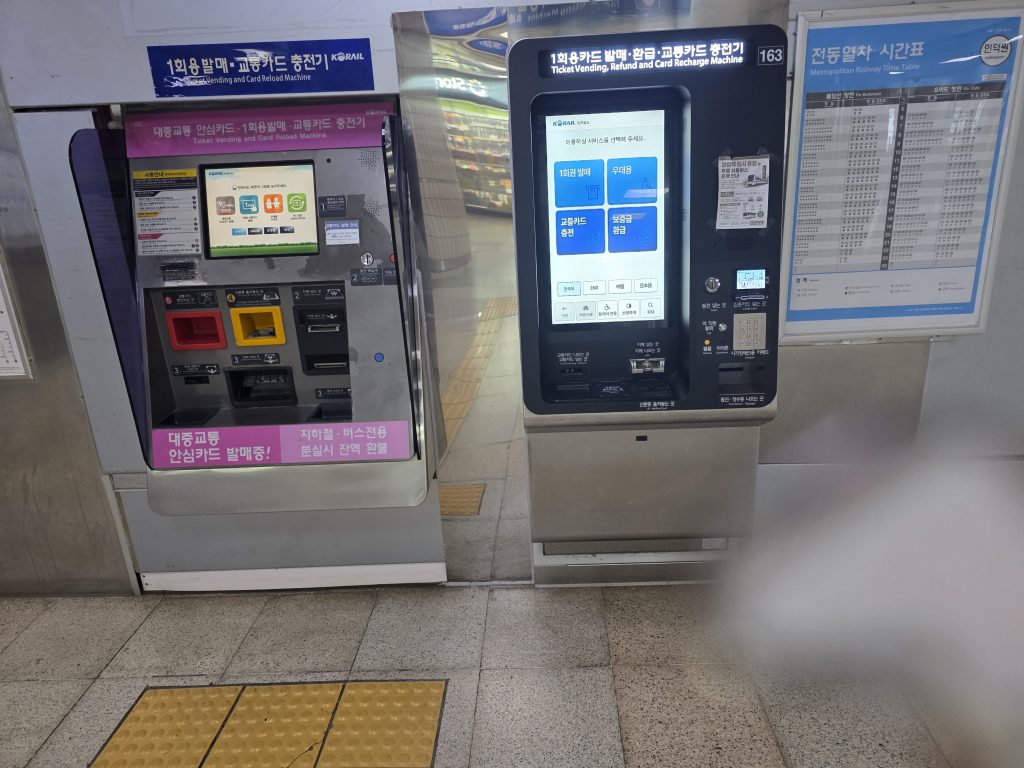
Our original photos show ticket machines and gates at Indeogwon Station on metropolitan Line 4 in Anyang, Gyeonggi-do. Photo walkthrough added October 14, 2026.
This Seoul subway guide explains transport cards, tickets, fares, transfers and common mistakes. Use it alongside our 3-day Seoul itinerary and our guide to where to stay in Seoul: Myeongdong, Itaewon or Gangnam.
On this page — tap to expand
- Your First Subway Ride: Six Simple Steps
- Choose a Transport Card or Single-Journey Ticket
- Seoul Subway Fares: Base Fare and Extra Charges
- Buying a Single-Journey Ticket: What to Check on Screen
- Korean Station Signs You Can Recognise
- Plan the Route Before Entering
- Find the Correct Platform and Train
- Tap In, Transfer and Tap Out
- Choose the Right Station Exit
- Airport Travel: AREX Is Not One Identical Service
- Should You Buy a Climate Card?
- Subway Etiquette and Practical Tips
- Frequently Asked Questions
Your First Subway Ride: Six Simple Steps
- Search for your destination in a route-planning app. Our Korea travel app guide compares maps, translation and transport tools.
- Buy a suitable transport card or single-journey ticket.
- Tap your card or ticket at the entrance gate.
- Check the line and direction before boarding.
- Follow transfer signs if you need to change lines.
- Tap out and follow the exit number for your destination.
Choose a Transport Card or Single-Journey Ticket
| Option | Useful for | Check first |
|---|---|---|
| Rechargeable transport card, such as Tmoney | Several subway and bus rides during a flexible itinerary | Card purchase cost, balance, supported recharge method |
| Single-journey subway ticket | An occasional ride without buying a reusable card | Fare, deposit and payment options on the machine |
| Climate Card short-term pass | Frequent travel within its eligible network | Current coverage, validity, exclusions and your actual routes |
Tmoney cards are available at participating convenience stores and other sales points. The card purchase price is separate from travel credit. Read the Korea Tourism Organization transport-card guide and confirm the available product at the sales counter.
Check the balance before travelling. Payment support differs by card, machine and shop, so keep Korean won available rather than assuming a foreign bank card can recharge every transport product. If you use a card with separate shopping and transport balances, confirm which balance funds your ride.
Seoul has introduced machines supporting international cards for Climate Cards and single-journey tickets at designated stations. For other machines and ordinary Tmoney top-ups, check the displayed payment options. See the official payment announcement.
Seoul Subway Fares: Base Fare and Extra Charges
The Seoul Metropolitan Government fare table, checked on October 1, 2026, lists an adult base fare of ₩1,550 with a transport card and ₩1,650 for a single ride, following the June 28, 2025 change.
Longer trips, airport journeys and certain services can cost more than the base fare. Check the total for your route.
VISITKOREA explains that a single-use subway card requires an additional ₩500 refundable deposit. After exiting, return the card to the deposit-refund machine. Read the official subway ticket guide.
Buying a Single-Journey Ticket: What to Check on Screen
At the machine: distinguish a ticket from a top-up
At Indeogwon Station (인덕원역), the machines examined for this guide show separate options for a single-journey ticket, transport-card charging and deposit refunds. On the newer machine, the labels include 1회권 발매 (single-journey ticket), 교통카드 충전 (transport-card top-up) and 보증금 환급 (deposit refund). Start by choosing the task you actually need; charging a reusable card is different from buying a ticket for one journey.
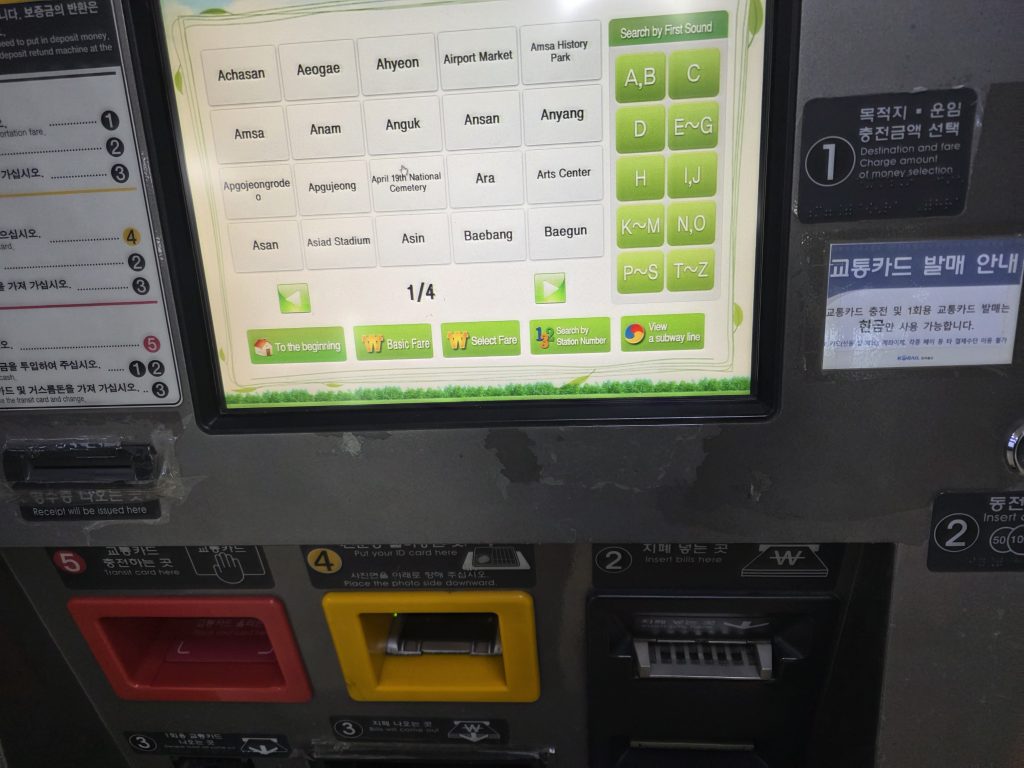
The newer machine has an ENG language button near the bottom of its home screen. The older machine’s English destination screen groups stations by their first letters and shows a page counter of 1/4, with arrow buttons for other pages. If your destination is absent, check the letter group and remaining pages before assuming the machine does not serve that station.
Other visible options include searching by station number and viewing a subway line. Match the full station name to your planned route, then check the fare shown before paying. The older machine displays a cash-only notice for transport-card charging and single-journey tickets. Other machines may offer different payment options.
At a ticket machine, select an available language you understand, choose your destination and review the ticket type, passenger category and total before paying. Follow that machine’s displayed payment options. Keep the single-journey card after tapping out: insert it into the separate deposit-refund machine at your destination to recover the 500-won deposit, as described in the KTO subway guide. A receipt is not the travel card.
Payment at a machine and payment at a station gate are different steps. Seoul’s March 17, 2026 announcement described foreign-card payment for single-journey tickets and short-term Climate Cards at 440 new machines in 273 stations on Lines 1–8, with an average service fee of about 3.7%. Check your machine’s payment logos and displayed fee. A bank-card ticket purchase is separate from tapping a valid transport card at the gate.
Korean Station Signs You Can Recognise
| Korean sign | Meaning | What to do |
|---|---|---|
| 타는 곳 / 승차 | Boarding area / boarding | Continue toward the platforms for your chosen line. |
| 환승 | Transfer | Follow it when changing lines within the station. |
| 출구 | Exit | Match the exit number to your destination route. |
| 방면 | Toward / direction | Compare the named stations with your route’s direction. |
| 일반 / 급행 | Local / express | Check that the service stops at your destination. |
| 충전 / 잔액 | Recharge / remaining balance | Use these when checking a stored-value transport card. |
| 보증금 환급 | Deposit refund | Look for this after exiting with a single-journey card. |
To ask staff, show “이 열차가 [destination]역에 가나요?” — Does this train go to [destination] Station? For an accessible exit, use “엘리베이터는 어디에 있어요?” — Where is the elevator? Keep the station’s Korean name from your route app ready to show.
Plan the Route Before Entering
Use Naver Map or KakaoMap to compare routes from your actual starting point to the attraction or hotel entrance. A station-to-station result can hide a long walk at either end.
Check the line number, direction, transfer station, destination exit and last useful departure. For your first ride, a route with one fewer transfer may be easier even if the estimated journey is slightly longer.
Download or save key details before leaving if you may lose mobile data. Screenshots are useful backups, but verify live departures and service notices when you travel.
Find the Correct Platform and Train
Line colors help, but use line numbers and station names as well. Platform signs usually show the next station or direction; compare these with your route before boarding.
Some services have branches or trains that terminate before your stop. Check the train destination. Express and local services may stop at different stations, so verify that the train serves the stop you need.
On Line 2, confirm the direction around the loop rather than boarding just because the platform has the right line number. If you are unsure, ask station staff before going through a gate or boarding.
Tap In, Transfer and Tap Out

At the gate: look for the marked card pad
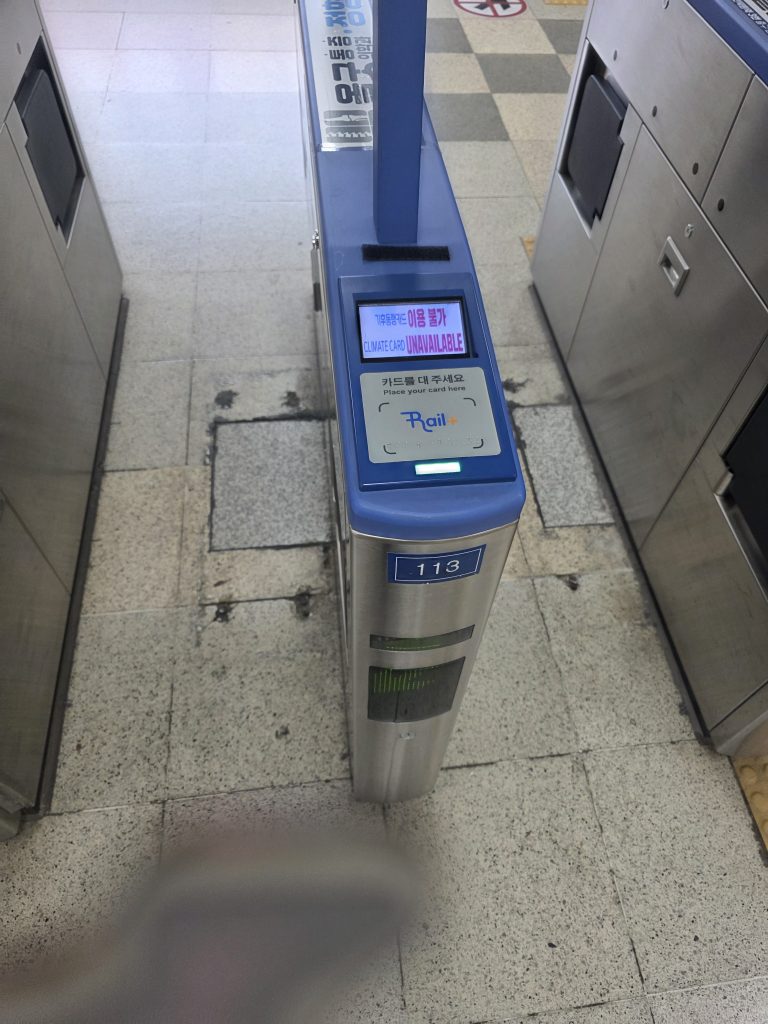
On the Indeogwon gate examined for this guide, the card reader is on top of the gate and has a labelled pad reading “Place your card here.” Place your valid transport card on that pad; the screen above it is for messages, not the tapping surface. Check that the lane is available for your direction before approaching.
Wait for a successful response before walking through. If the gate does not open, move aside and read the message or ask station staff. Repeatedly trying other lanes is less useful than establishing whether the problem is your balance, ticket or pass coverage.
Hold one transport card against the reader at the entrance and wait for confirmation before moving through. Keep other contactless cards away from the reader to avoid interference. Each passenger should have the appropriate ticket or card.
For a subway transfer, follow the signs for the next line through the designated passage. Do not leave through an exit gate just because you are changing trains. Some connections have special gate arrangements; follow the signs and ask staff when uncertain.
Tap again when leaving your destination station. If the gate refuses your card, check the balance and contact staff instead of repeatedly trying different gates.
When using eligible bus–subway transfers, tap when boarding and getting off each vehicle. Seoul’s published integrated-fare rules require a transfer within 30 minutes, extended to 60 minutes between 9 PM and 7 AM. Eligibility and extra distance charges still matter: a transfer is not automatically a completely free trip.
Choose the Right Station Exit
Exit choice can change your walk significantly. Check which numbered exit is closest to the attraction entrance, and use an elevator route if stairs or luggage are a concern.
| Destination | Useful station reference | Avoid this mistake |
|---|---|---|
| Myeongdong | Myeongdong, Line 4; Euljiro 1-ga, Line 2 for some hotels | Assuming every Myeongdong hotel uses the same station |
| Itaewon | Itaewon, Line 6; nearby stations depend on your address | Ignoring uphill streets after the station |
| Gangnam Station area | Gangnam, Line 2 and Sinbundang Line | Assuming all Gangnam-area hotels are beside this station |
| Gyeongbokgung | Gyeongbokgung, Line 3 | Ignoring the walk to the palace entrance |
| Seongsu | Seongsu, Line 2 | Confusing a neighborhood stop with the exact cafe location |
| Ttukseom Hangang Park | Jayang, Line 7 | Choosing Ttukseom Station on Line 2 by name alone |
Use your map app to choose the entrance and accessible route from your accommodation.
Airport Travel: AREX Is Not One Identical Service
The Airport Railroad connects the airports and Seoul, but the express and all-stop services have different ticket arrangements and stopping patterns. Choose the service that fits your hotel route, luggage and arrival time. Consult Seoul’s official airport transport guide before buying a ticket.
Do not assume a city pass includes every airport service. If you arrive late, check whether your chosen train and connecting subway will still operate, and confirm your hotel’s late check-in arrangements. For hotel-specific routes and alternatives, see our Incheon Airport to Seoul transport guide.
Should You Buy a Climate Card?
A real example: “Climate Card Unavailable”
A reader at Indeogwon displays 기후동행카드 이용 불가 / CLIMATE CARD UNAVAILABLE on the reader. This demonstrates why a station can accept ordinary transport cards while a particular unlimited pass is unavailable.
Seoul’s official Climate Card guidance explicitly uses a journey ending at Indeogwon as an example of travel outside its service range. Check both your boarding station and destination before relying on the pass. A connected subway line does not mean every station on that line is included.
Climate Card coverage guidance checked October 14, 2026.
Compare the current short-term pass conditions with your planned journeys. It can be worth considering for frequent eligible rides, but an occasional traveller may prefer pay-as-you-go credit. Check the official Climate Card coverage rather than relying on an old map.
Before buying a pass, check its validity period and coverage for your planned stations and airport journey.
Subway Etiquette and Practical Tips
Let people get off before boarding, stand clear of doors and keep calls quiet. Follow priority-seat signs and give space to passengers who need it. Carry backpacks so they do not block others.
Allow extra time with children, large luggage or a wheelchair. Check elevator routes rather than assuming every exit is accessible. During busy commuting periods, a less ambitious schedule makes travel more comfortable.
There is no single last-train time for the whole network. The final useful train depends on your station, direction, destination and transfers. Check your return route before an evening out.
Frequently Asked Questions
Can I use my foreign bank card directly at every gate? Do not assume so. Use a ticket or transport product accepted by that gate; buying a ticket with a bank card is different from tapping that bank card to travel.
What if I board in the wrong direction? Get off at the next practical stop and check the route. Ask staff if switching platforms requires leaving the paid area; do not assume every re-entry will be free.
How much should I load? Start with enough for your planned rides and check the remaining balance regularly. Distance charges and additional journeys can increase spending.
Is the subway enough for a three-day visit? It can cover many useful journeys, but buses and walking may suit particular stops better. Compare routes instead of forcing every journey onto a subway line.
Use the Subway to Connect Your Seoul Plans
Once you understand gates, directions and exits, use our 3-day Seoul itinerary to group your journeys. If you have not booked accommodation, compare Myeongdong, Itaewon and Gangnam as hotel bases.
For places and experiences to add to your route, explore the best things to do in Seoul.
Information checked: October 1, 2026. Confirm current fares, pass coverage, service notices and departure times before travelling.